
In a condominium or cooperative, the people you bill own their units. They pay common charges (or maintenance) based on their common interest, not rent under a lease. UnitConnect records them as tenants, but whenever the property's building type is Condominium or Cooperative, the wizard and the tenant record switch to ownership wording and fields.
Add the owner
- In the sidebar, click Tenants, then click + (Add tenant).
- In Tenant Info, pick the unit in the condo or co-op property and enter the owner's name. Click Next.
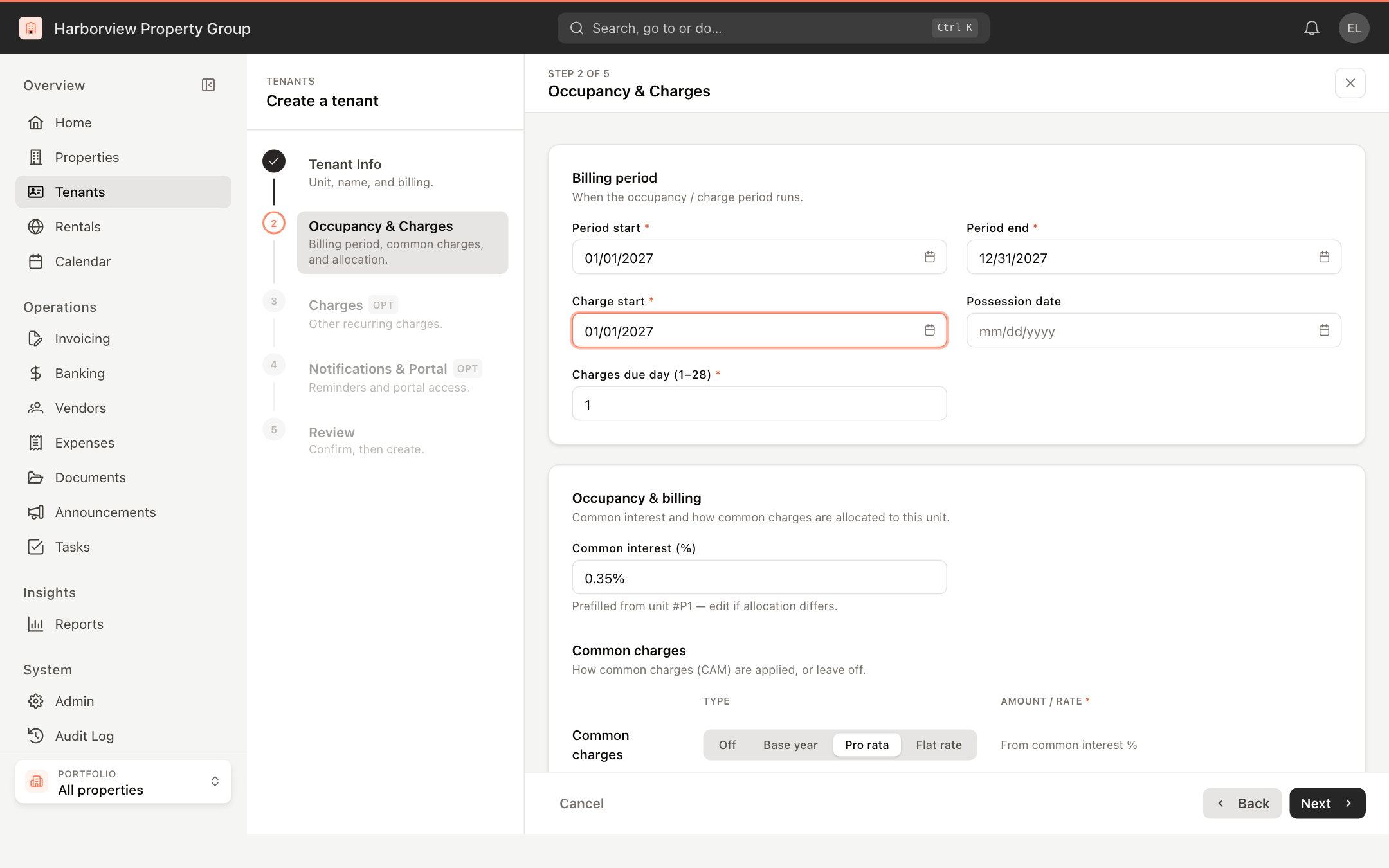
- The second step is called Occupancy & Charges. Under Billing period, enter:
- Period start and Period end — when the occupancy and charge period runs.
- Charge start — when billing begins.
- Possession date (optional).
- Charges due day (1–28).
- Under Occupancy & billing:
- Common interest (%) is prefilled from the unit. Change it if the allocation differs.
- Under Common charges, choose how common charges are allocated: Off, Base year, Pro rata (from the common interest percentage) or Flat rate. Base year and Flat rate need an amount.
- Click Next. On Charges, add any other recurring charges, such as parking or storage.
- On Notifications & Portal, choose reminders and portal access. Lease-only reminders (lease expiration and renewal options) are not offered for ownership units.
- Review and click Create tenant.
The Charges tab
For an ownership unit, the tenant's Lease tab is called Charges, and it shows:
- Common Charges — the common interest, the allocation, the Monthly amount, Frequency and start and end dates of the common charge. Click Edit monthly charge to change the amount, or the pencil (Edit common-charge allocation) to change how it is allocated.
- Recurring Charges — every other recurring charge on the unit. See Recurring and additional charges.
- Occupancy & Billing — the billing period, Charges due day, Charge start, Possession, Late fee and Admin fee. Click the pencil to change them.
There is no rent breakdown for ownership units, and the tenant header shows the occupancy period without a monthly rent.
Whether a unit is treated as an ownership unit comes from its property's building type. To change it, edit the property. See Update property information.
For one-off special assessments across all owners, see Assessments for condominiums and cooperatives.